


Let me start with an admission that will cost me whatever credibility I have left, which was never much.
I love Zohran Mamdani. I think what he is doing to American politics is the most exciting thing to happen to that country in years. I have read so much about New York City primaries that last week a German couple asked me how far Hwange was from their lodge and I nearly answered “roughly the same distance as the gap between the DSA and Hakeem Jeffries.” I stopped myself, mostly because I could see they had no idea who either of those things was. I am a tour guide in Victoria Falls. My job is elephants. Yet here I am at midnight, emotionally invested in a Brooklyn assembly seat like it owes me money.
And yet.
In June, the New York Knicks won the NBA Finals, their first title in fifty-three years, by beating the San Antonio Spurs four games to one. In the process they crushed a seven-foot-four French alien named Victor Wembanyama, who is my favourite basketball player alive and possibly the most beautiful thing to happen to the sport since someone decided the ball should bounce. So I now live in a special kind of hell, politically rooting for a city whose basketball team made me lie face down on my bed and question my life choices. You can support the revolution and still be personally wounded that the revolution’s jump shot was falling in Game 4.
Anyway. The news is bigger than my sporting trauma, so let me explain what is actually happening.
First, who is this Mamdani person?
Zohran Mamdani is the mayor of New York City. He is a democratic socialist, he is in his thirties, and two years ago he was an obscure state assemblyman from Queens, the kind of politician so minor his own committee assignments probably surprised him.
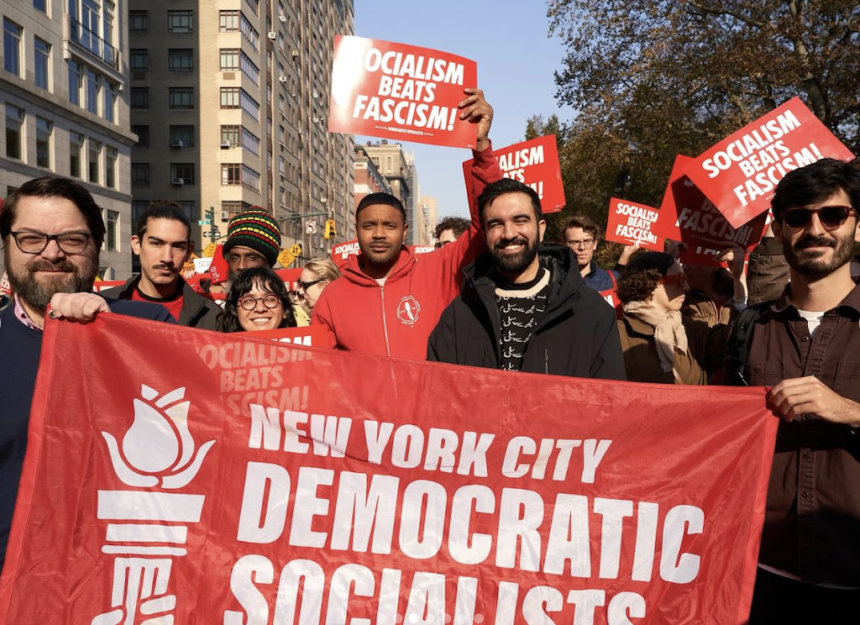
Then he ran for mayor of the biggest city in America, against a former governor with a famous surname and basically the entire Democratic machine, and he won. He did it with an army of volunteers and a relentless focus on one thing: the cost of living. Rent, groceries, childcare, transport. Not slogans, not culture war, just the boring arithmetic of whether an ordinary person can survive the month. It turns out that when you talk to people about the thing keeping them awake at night, they vote for you. Revolutionary stuff.
For those of us watching from Africa, a young outsider promising to fix the basics while the old guard clutches its chest is a familiar genre. We have seen this film. We know it can end in triumph. We also know it can end with a man discovering, thirty years later, that he simply cannot find the exit. But more on that later.
What is democratic socialism, actually?
Here is where most explanations either lie to you or bore you into a coma. I will attempt neither, though I once bored an entire safari vehicle unconscious explaining basalt, so manage your expectations.
Democratic socialism is not the Soviet Union. It is not gulags, and it is not your uncle’s 4am WhatsApp forward about the government coming to nationalise his goats. The “democratic” bit is the entire point. It is socialism that insists on winning elections, obeying courts, and leaving office if voters get sick of it. Karl Popper spent his career arguing that the real test of a free society is whether you can remove your leaders without a coup. Democratic socialists, the honest ones, sign up for that test on purpose.
In practice, in America, it is a fairly specific menu. Government-run healthcare so a hospital visit does not bankrupt you, the way it does now, where a single ambulance ride can cost more than a used car. Rent controls and public housing. Higher taxes on the very rich. Stronger unions. A federal minimum wage that has not budged from $7.25 an hour since 2009, which they would like to roughly double. To an American raised on Cold War reflexes, this sounds like Lenin is coming for the fridge. To a European it sounds like an ordinary Tuesday. To a Zimbabwean it sounds like the fever dream of a country rich enough to argue about healthcare instead of queuing for fuel.
And the thing everyone forgets is that this is an old American tradition in a new outfit. Eugene Debs ran for president as a socialist over a century ago and pulled nearly a million votes, some of them from a prison cell. Martin Luther King Jr., in the years before he was murdered, was talking about poverty and economic justice in language that would get him screamed at on cable news today. America has always had a socialist streak. It just spent seventy years pretending it was allergic to itself.
So what actually happened?
Winning City Hall was one thing. Any charismatic outsider can win one race. What made people sit up was what he did next.
Barely six months into the job, instead of playing it safe, Mamdani waded into a batch of congressional primaries and endorsed insurgents against sitting members of his own party. In several cases he went directly against Hakeem Jeffries, the leader of House Democrats, in Jeffries’ own New York backyard, which is the political equivalent of insulting a man’s cooking in his own kitchen while eating it. And his candidates kept winning.
Three races tell the story. In lower Manhattan and Brooklyn, in one of the most Jewish districts in the entire country, a former city comptroller who called Israel’s actions in Gaza a genocide and refused money from AIPAC, the big pro-Israel lobby, beat a two-term incumbent by more than thirty points. Thirty. In a district where the pro-Israel lobby was supposed to be strongest. In a Queens and Brooklyn seat with no incumbent, a democratic socialist union organiser won and ended her victory speech with “abolish ICE, free Palestine, join DSA,” which is not a line you usually hear from an incoming member of Congress. And in the wildest race of the night, a thirty-two-year-old public defender who had never run for anything in her life unseated a seventy-one-year-old congressman who chairs the Congressional Hispanic Caucus, by less than four points, after Mamdani reportedly broke a private promise to back the incumbent and switched sides.
Then it stopped being just New York. In Denver, a twenty-nine-year-old beat a congresswoman who first won her seat four months before the challenger was born. Sit with that. The winner was still a rumour in the maternity ward when her opponent took office. The difference between them came down to almost a single issue, Israel policy, and outside groups linked to AIPAC spent over a million dollars trying to stop her. They lost.
The pundits are calling it the “Mamdani effect,” which is a fancy name for a simple thing. He proved it could be done, and now candidates in Philadelphia, Denver, and elsewhere want to try it in their own towns.
Why this is genuinely a big deal
Time for my serious face, the one I use when a tourist asks whether the bungee cord has ever snapped.
The real story is in the polling. Depending on which survey you believe, roughly two-thirds of Democrats now view socialism favourably, and fewer than half feel the same about capitalism. Among the most liberal voters, the socialist movement polls better than the Democratic Party’s own leadership. Read that twice. A big chunk of the party likes the rebels more than the people running the party.
That is not a fringe. That is a fault line.
What is driving it is not a sudden urge to read Marx on the subway. It is rent. It is medical bills. It is a generation who did everything they were told, got the degree, took the job, and still cannot afford the life their parents treated as the bare minimum. When a system stops delivering the basics, people stop caring what you call the alternative. Hannah Arendt saw this decades ago: movements grow in the empty space left by institutions that stopped listening. The establishment did not lose these races because socialism is seductive. It lost because it forgot to be useful. That difference is the whole ballgame.
And this is where it clicks for me as an African. The most powerful force in politics is not ideology. It is the feeling of being ignored. We know that in our bones. Liberation movements are born from it, and, if we are honest, they sometimes forget it the second they get comfortable in the good chairs.
A warning, from a continent that has read the sequel
I am rooting for Mamdani, loudly. But I have spent my whole life on a continent where thrilling young movements promising to serve the people occasionally curdle into something that serves mostly themselves, and their nephews. I have watched the word “revolutionary” stretched so far it eventually covered a fleet of Range Rovers. So when I see a movement rising, half of me cheers and the other half whispers: stay humble, stay democratic, and please, for the love of everything, be willing to actually lose an election one day.
The beauty of what Mamdani represents is precisely that it insists on democracy. The danger, every time, is the moment a movement decides it has become too important to be voted out. Frantz Fanon warned about exactly this, the way yesterday’s liberators slip into the old costumes and start rehearsing the old lines. America is not Zimbabwe, and I am not predicting doom. I am simply a man who has read enough history to keep one eyebrow permanently, involuntarily raised.
So, are Americans becoming socialist?
Not all of them, probably not most of them. Every race the socialists have won so far has been in a safely Democratic district, where a Democrat was going to win regardless, which is a little like winning a swimming race in your own bathtub. The real test comes when one of them runs somewhere it could actually cost them, somewhere “socialist” is a liability instead of a badge. Upcoming primaries in states like Michigan, Wisconsin, and Florida, with far more mixed politics than New York City or Denver, will tell us far more than anything so far. We do not yet know whether this is a national movement or a very loud urban one.
But something is moving. A generation raised to treat socialism as a swear word has looked at its rent, its medical bills, and the people in charge, and decided the swear word deserves a second date. Whether that becomes a lasting movement or a gorgeous moment that fizzles, nobody honestly knows. Not the pundits, not the pollsters, and certainly not a man typing this while the spray from the Falls slowly ruins his laptop.
What I do know is that it is one of the most interesting things happening in politics anywhere on earth, and it deserves to be understood rather than feared.
And I know one other thing with total certainty. I will support Zohran Mamdani, I will read every primary result like a Grand Slam final, and I will do all of it while still, in the quiet of my own bitter heart, refusing to forgive his city for what it did to Wembanyama in June.
A man can hold two truths at once. That the future in America might just be a bit brighter than we feared. And that the Knicks can take their trophy and go home.