


I want to be honest about how I have spent the last few days, because a serious blog demands a serious confession.
I have been researching a man who dresses as a wheelie bin.
Not casually. Not as a break between real work. I have gone deep. I have read his manifesto. I have opinions on his manifesto. Somewhere around the third article, I caught my reflection in my laptop screen at midnight in Victoria Falls, a grown man, a basketball coach, a person with actual responsibilities, nodding thoughtfully at a policy proposal to move a hand dryer in a pub toilet to a more sensible position. And I thought: this is it. This is the moment the algorithm finally broke me.
His name is Count Binface. He is running for Parliament against Nigel Farage. And I need him to win with a desperation I cannot fully justify and refuse to apologise for.
Let me explain how we got here, because underneath the absurdity is a genuinely clever story about power, embarrassment, and the quiet British art of refusing to give a man the fight he wanted.
First, what actually happened
Nigel Farage, for the uninitiated, is the leader of Reform UK, a hard-right populist party that has been topping British opinion polls. He was one of the chief architects of Brexit, he is a longtime friend of Donald Trump, and he has spent decades presenting himself as the plucky outsider battling a sneering establishment, despite being a former commodities trader who has been on television since roughly the invention of television.
This week, Farage did something dramatic. He resigned as the Member of Parliament for Clacton, a seaside seat in the southeast of England, in order to trigger a by-election, which is what the British call a special election to fill a single empty seat. He framed it grandly. The people of Clacton, he said, should “be the judge of my actions.” A noble contest, him against the establishment, democracy in its rawest form.
The reason for all this nobility is less noble. Farage is being investigated by Parliament’s standards watchdog over allegations that he failed to declare a gift reportedly worth around five million pounds from a wealthy party donor. Members of Parliament are required to declare that sort of thing, on the theory that the public might like to know who is quietly funding the people who govern them. If the investigation found against him and recommended a suspension of more than ten days, that could itself have triggered a by-election through a recall petition.
So Farage, rather than wait to be pushed, jumped. He called the by-election himself, hoping to turn a humiliating investigation into a heroic re-election. Get ahead of the scandal. Control the story. Ride back into Parliament on a wave of his own making.
It has not gone to plan.
The establishment declined to show up
Here is the part I find genuinely brilliant, in a cold, tactical way.
Farage wanted a fight against the establishment. So the establishment simply refused to fight. Labour, the Conservatives, the Liberal Democrats, the Greens, Rupert Lowe’s Restore Britain, one by one, they all announced they would not stand a candidate. Kemi Badenoch, the Conservative leader, called it a “fake by-election.” A Labour spokesperson called it “pathetic.” The Liberal Democrats refused to give “oxygen to Farage’s vanity project.”
My favourite response came from Rachel Reeves, the finance minister, who as a technicality had to formally accept Farage’s resignation. She noted that the whole thing was a farce, and then added that if Farage wanted to spend his summer arguing with a bin, she would not stop him. When your own Chancellor of the Exchequer is roasting you in a single sentence, the day is not going well.
At first this looks like madness. By not standing, are they not just handing Farage an easy win? Yes. Completely. But that is the trick. A landslide victory means nothing if nobody agreed to play. You cannot beat the establishment if the establishment yawns, checks its watch, and wanders off. Worse, with no serious opponents to argue about, the media spotlight has nowhere to go except straight back to the five million pounds Farage would very much like everyone to stop mentioning.
There is precedent for this. In 2008, the Conservative MP David Davis resigned and forced a by-election as a protest, and the main parties refused to stand against him. He won with 72% of the vote, and it is remembered as a damp, forgettable squib. Winning a race nobody enters is not a triumph. It is jogging alone and calling it the Olympics.
Enter the bin
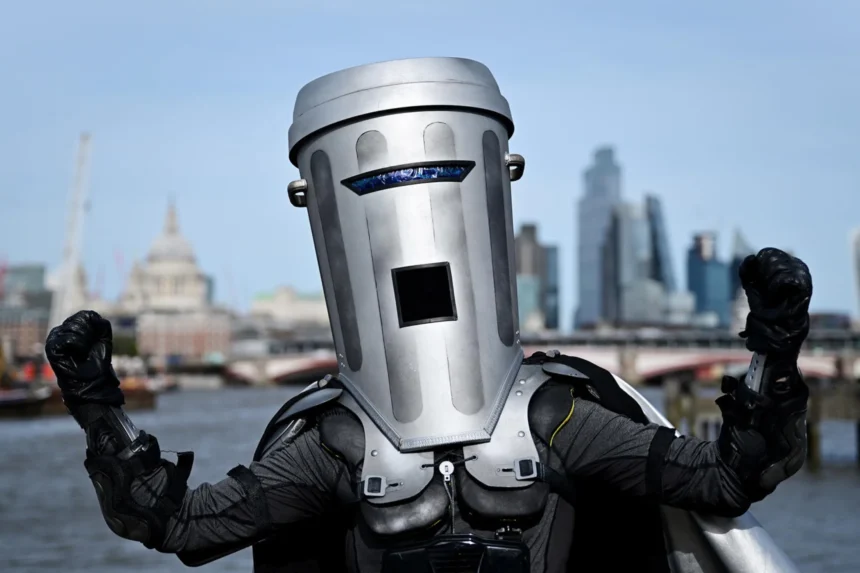
Into this vacuum, dressed head to toe as a black wheelie bin with a glowing visor, stepped Count Binface.
The man behind the bin is a comedian and scriptwriter named Jon Harvey, who has worked with Armando Iannucci, the mind behind Veep and The Thick of It, which explains a great deal about the quality of the satire. He first ran in 2017 as “Lord Buckethead,” then rebranded into Count Binface, a self-described “space politician” who has now stood against three sitting or aspiring British prime ministers. His entire tradition, joke candidates standing in the seats of the powerful, goes back decades in Britain, most famously to the late Screaming Lord Sutch of the Monster Raving Loony Party.
Binface has a “full and costed manifesto,” and became genuinely indignant on BBC Radio 4 when a host dared suggest otherwise. Among his policies: building “at least one” affordable home, renaming London Bridge as Phoebe Waller-Bridge, nationalising the singer Adele, forcing rule-breaking cyclists to ride unicycles, and appointing himself the UK’s Eurovision entry for 2027. Asked on the BBC what his appeal to the voters of Clacton would be, he gave the only answer that matters: “That I’m not Nigel Farage.”
And here is where the joke stops being entirely a joke. Because a lot of people appear to agree with him.
The bit where it gets real
A poll by Ipsos, conducted on the 8th and 9th of July, asked the British public a straightforward, absurd question: in a head-to-head, who would you prefer to win Clacton, Farage or Binface? A third of Britons, 33%, said Binface. Just 21% said Farage. The bin is beating the potential future prime minister by twelve points.
Now, an important cold shower. National polls are not the same as the actual voters of Clacton, which is a genuinely pro-Farage seat, and Binface himself has admitted he will “probably not” win. The bookmakers agree, putting Farage at odds-on and Binface a distant second. But the same Ipsos poll found something Farage cannot laugh off: 74% of Britons think the standards investigation should be happening at all, and 73% think it should continue even if he wins the by-election. The scandal does not disappear with a victory. The investigation grinds on regardless, and a second Clacton by-election, a real one this time, could follow later in the year, with the establishment fully intending to show up for that one.
So Farage may well win in a few weeks, and still lose. He wanted to bury a story about undeclared money. Instead he has spent a week being ridiculed in the House of Commons, where the veteran MP David Lammy summarised the contest to roars of laughter as the “City trader, Putin-admiring, professional politician who is pals with crypto billionaires versus Count Binface.” When the funniest description of your predicament is delivered from the despatch box, the by-election has already done its work.
Why a Zimbabwean is emotionally invested in a British bin
Here is where I have to be honest about the “deepest, most unrealistic parts of me,” because that is what you came for.
I know Binface will almost certainly not win. I know that. And yet some stubborn, joyful, deeply unserious chamber of my heart wants it so badly that I have checked the odds twice today. I think I understand why, and it is not really about Britain.
I have spent my whole life on a continent where powerful men treat elections as coronations, where “the will of the people” is invoked most loudly by the people least interested in it, and where the scandal is never buried because the man simply refuses to allow the story to end. I have watched leaders wrap personal survival in the language of the people versus the establishment while being, quite obviously, the establishment. So there is something almost medicinal about watching a democracy strong enough to answer a powerful man’s grand stand not with fear, not with force, but with a comedian in a bin costume and a national shrug.
That is the thing satire does that outrage cannot. Vaclav Havel, the playwright who helped bring down a dictatorship and then accidentally became a president, understood that authoritarian power feeds on being taken seriously, on fear, on the sense that it is inevitable and immovable. The one thing it genuinely cannot survive is laughter. You can arrest a protester. You can out-argue a rival. You cannot look dignified standing next to a man dressed as a bin who is polling higher than you. Farage wanted an epic. He got a punchline. And a healthy democracy is precisely one that can afford to make a punchline of a man who would prefer to be a martyr.
The honest ending
Let me not oversell it, because I promised you facts and not just feelings. Binface will very likely lose. Farage will very likely return to Parliament. Reform UK is still topping the polls, and none of the deeper forces that made Farage powerful, the anger, the alienation, the sense of a whole country left behind, are solved by a joke. Laughter is not a policy. A bin cannot fix a health service or a housing crisis. The problems that built Farage will still be there long after this strange little summer contest is forgotten.
But something in this week has genuinely lifted me, and I am done pretending otherwise. A powerful man tried to manufacture his own heroic story, and an entire political system, plus a third of the public, plus a comedian from another planet, calmly declined to give it to him. They refused to be afraid. They refused to play along. They just laughed.
I hope the people of Clacton do the funniest thing imaginable. I know they probably will not. But for a few more weeks, from a café next to the largest waterfall on earth, I am going to allow myself the small, stupid, glorious hope that somewhere in England, a bin might just beat a would-be king.
And if that makes me unserious, then fine. I have read the costed manifesto. I stand with the Count.