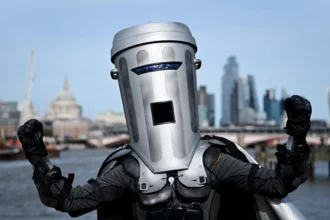


I have already written one article about Count Binface.
That felt like enough. One article about a British man in a wheelie bin is a reasonable lifetime allocation for a Zimbabwean tour guide. Then I did a little more reading, purely to confirm I had squeezed the last drop of comedy out of him. And I found something that made me sit very still at my desk. So now you have to hear about it too, because I refuse to carry this alone.
Let me begin with the ridiculous, because there is plenty of it, and because you deserve to laugh before I do this to you.
The greatest loophole in British democracy
Here is how you stand for Parliament in Britain. Get a few people to sign a form. Pay a deposit of five hundred pounds. That is it. That is the entire gate. You are now on the ballot next to the Prime Minister of the United Kingdom. Doesn’t matter if you are a career politician in a tailored suit or a man dressed as a fish finger.
And then comes the beautiful part.
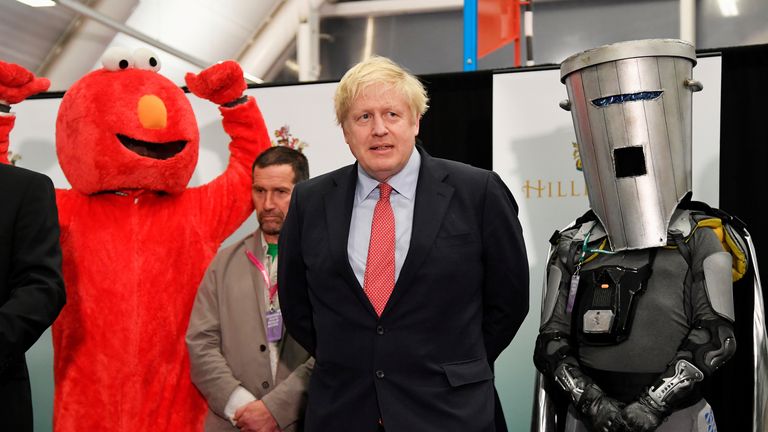
On election night, the law requires every candidate in a seat to stand together on the stage while the result is read out. Shoulder to shoulder. All of them. No exceptions.
Which means the most powerful person in Britain must stand on live television, before the entire nation, next to whatever lunatic paid the five hundred quid. He cannot leave. He cannot object. He must simply stand there and take it.
This is how you get the defining image of modern British politics. A visibly furious Prime Minister, waiting to learn if she still has a job, beside an alien in a bin who is five thousand years old, recently arrived from the planet Sigma IX, and demanding the return of Ceefax.
Zimbabwe, I say this with love: we could never. Our leaders would not survive contact with a bin. The bin would win, and then the bin would be arrested.
The manifesto, where I stopped laughing
I read the Count’s manifesto expecting nonsense. I found nonsense. Then I found myself agreeing with it, which was an unwelcome development.
He wants the bosses of Thames Water, the company pumping sewage into England’s rivers while posting a profit, to personally take a swim in the Thames. To see how they like it.
He wants every government minister’s pay tied to a nurse’s pay for the next hundred years.
He wants to build, and this is a direct quote, “at least one affordable house.”
He wants croissants price-capped at one pound. He blames Liz Truss for the extra ten pence.
He wants the Parthenon marbles returned to Greece, addressing the British Museum, again a direct quote, as “you thieving bastards.”
You laugh. Obviously you laugh.
Then you sit with it for half a second and notice something uncomfortable. Tie ministers’ pay to nurses’ pay. Make the water executives swim in what they dumped. The man in the bin is making more sense than the men running the country. That is not a joke about the bin. That is a fact about the country.
He is not a clown. He is a professional.
The man inside the bin is Jonathan David Harvey. Jon to his mates. Born in Croydon, 1980. He did not wander out of a pub on a dare. Jon Harvey has spent thirty years as one of the sharpest comedy writers in Britain, working entirely behind the camera. He has written for Have I Got News for You. He worked on The Thick of It. He helped bring back Yes Minister. He has written for John Oliver in America.
His videos have been watched over seventy million times. In 2019 the New Yorker named one of his gags, a Boris Johnson parody, among the jokes of the year. He also read classics at Oxford. Greek, Latin, ancient history, the lot.
Sit with that, because it is the whole key.
The fool. The jester. The one person permitted to stand before power and mock it to its face. The only man in the throne room allowed to say the unsayable. That is not a modern gimmick. It is one of the oldest political technologies humans have ever built, and the Greeks were doing it on stage while the politicians squirmed in the front row.
Harvey spent his twenties reading about exactly that.
The man in the bin is not improvising. He has, more or less, a degree in this.
The bin is not even his first costume
In 2017 he stood as Lord Buckethead, a space villain lifted from an obscure 1984 Star Wars knock-off. He ran against Theresa May in her own seat. He got 249 votes. The photograph of a stone-faced Prime Minister standing next to a man in a bucket went around the world.
His entire plan had been to get one photo. By that Sunday he was on a first-class flight to New York to appear on John Oliver’s show.
Then he lost everything. The American filmmaker who created Buckethead turned up and pointed out, quite correctly, that he owned the character. He took it back, including the social media following Harvey had built from scratch.
At the next election, a rival, official Lord Buckethead stood in the same seat and beat him. Robbed of his character, then defeated by a copy of himself. Most people would have quit on the spot.
Harvey built a new character nobody could ever take from him. He swapped the bucket for a bin, partly because, as he put it, politics is rubbish. He wrote the betrayal into his own lore, joking that he had respawned after an unfortunate battle on the planet Copyright.
Then he simply kept going.
Sixty-nine votes against Boris Johnson. Ninth place and nearly 25,000 votes running for Mayor of London, beating UKIP and Piers Corbyn. Three hundred and eight against Rishi Sunak, his personal best, which he marked by reminding Sunak to his face that you do not skip D-Day.
Sadiq Khan, on winning the mayoralty, thanked Binface by name from the stage and called him another reason to love London.
Every time, he pays the five hundred pounds. Every time, he loses it.
Which left me with a question I could not shake.
Why? There is no money in it. He already has the fame. He is a successful writer who does not need any of this. Why would a man this bright, already robbed once and beaten by a fake of himself, keep climbing into a dustbin to lose, year after year?
Then I found the answer. And I have to warn you, this is where it stops being funny.
Dan
Jon Harvey grew up in a chaotic house. His father was, in Jon’s own words, a fun, loving, creative man who gave him his love of writing. He was also an alcoholic. Eleven houses in eleven years.
What got Jon through it was his older brother, Dan. Nine years older. Old enough, Jon has said, to be almost like a second dad. The two of them bonded over the two things that would go on to define Jon’s entire life: comedy and politics. They quoted Blackadder at each other for hours. In 1992, when Jon was twelve, Dan dragged him along to the local election count at Croydon Town Hall, beaming, purely because he thought it would be a laugh.
A comedy-obsessed man treating an election count like the best night out in town. Hold that image. On the 9th of June 2015, Dan missed Sunday lunch and did not answer his phone.
Jon went round to his flat and found him dead. He was forty-three. Undiagnosed diabetes. Nobody saw it coming.
Jon inherited Dan’s Crystal Palace season ticket, held for twenty-six years, even though Jon supports Spurs, because he could not bear his brother’s seat sitting empty. Then he travelled the country and the world for a year, going to every sporting event the brothers had always meant to attend together and never did.
He has written that none of it could replace Dan. But that by celebrating the things his brother loved, he was keeping his fire flickering, and in a small way it meant Dan was still with him.
And here is the fact that made me close my laptop and go stand outside for a while.
Jon Harvey first put on that costume and stood in an election in June 2017.
Almost exactly two years to the day after he found his brother’s body.
He has never quite said in plain words that he does all of this for Dan. But he has come as close as a person can, describing Count Binface and that year of grief-driven pilgrimage as two sides of the same coin. A coin, he said, minted by my brother.
Comedy and politics. The two things Dan loved most.
So every time Jon Harvey climbs into a dustbin and stands beside a Prime Minister on live television demanding the return of Ceefax, he is doing the thing his big brother loved most, in the place his big brother would have adored, on exactly the kind of night Dan once dragged him to for fun when he was twelve.
He is keeping a light on that should have gone out in 2015.
He and his wife later had a son. They gave him the middle name Daniel.
So why should a Zimbabwean care about a British bin?
Fair question. I have asked it of myself, mostly at 1am, mostly out loud.
Here is my answer.
Watch what actually happens in Clacton. A man in a costume insults the Prime Minister on national television. He calls a museum full of thieves. He tells a sitting leader to his face that he shirked D-Day.
And then he goes home. Nothing happens to him.
Nobody visits his house. No unmarked vehicle idles outside. His phone does not go quiet. He is not charged with undermining the authority of the office, or communicating falsehoods prejudicial to the state, or whatever we are calling it this month.
He is simply allowed to be rude to power, in public, forever.
That is not a small thing. That is the whole thing.
We know what the alternative looks like. In our part of the world, a cartoonist gets a visit. A comedian gets a charge. A citizen makes a joke on Twitter about a leader’s health and discovers, quite quickly, that the state has no sense of humour whatsoever. We have watched people arrested for insulting the office of the President. We have watched satire become a legal risk assessment.
And this is the part I want you to really hear. That fear is not incidental. It is the point.
A government that cannot be laughed at is a government that has quietly stopped being accountable, because mockery is just accountability without a permit. It is what citizens reach for when the courts are slow, when the press is captured, and when the ballot has been arranged in advance.
Vaclav Havel, the playwright who mocked a dictatorship until it collapsed and then found himself accidentally running the country, understood this exactly. Authoritarian power does not actually run on violence. It runs on everybody agreeing to take it seriously. It needs your solemn face. It needs you to nod. The whole structure depends on the pretence, and the day people stop pretending, it starts to come apart.
That is why the bin terrifies them. Not because a bin can win an election. Because a bin proves the emperor can be laughed at, and once a nation has seen that, it cannot unsee it.
So what do we do with this?
We stop treating the freedom to mock as a luxury item, a bit of Western indulgence we will get to once the economy is fixed. It is not the reward for a functioning democracy. It is one of the load-bearing walls.
We defend the comedians, the cartoonists, the satirists, the loud ones on Twitter, even when they are not funny, even when they are annoying, even when they are mocking the side we happen to like. Especially then. A right you only extend to people you agree with is not a right. It is a favour, and favours can be withdrawn.
And we remember that the point of Binface is not the bin. It is that a system exists which cannot stop him. That is what we should want. Not the costume, the permission.
Make your vote count
There is a fair criticism of joke candidates. That they cheapen democracy, that they make a mockery of a serious business.
It keeps crashing into one stubborn fact.
In every single contest Jon Harvey has ever entered, the man with a bin on his head was never the most ridiculous person on that stage. And never the least honest.
He raises money for homelessness charities through the whole thing. A voter at one of his campaign events turned to him and said, sincerely, that Binface was making the most sense of all the candidates.
He still has not won. He probably never will. He will lose his five hundred pounds again in Clacton, and he will be back, bin and all, at the next one.
His campaign slogan has never changed since the very first day. Three small words, which read differently now than they did when you started reading this.
Make your vote count.
I came looking for a joke.
I found a grieving little brother keeping a promise he never made out loud, in the only way he knew how. Through comedy. Through politics. Through a bin.
And I found a country that lets him.
I would like both of those things for us, one day. The freedom to be that rude to power, and the kind of love that makes a man put a bin on his head for a decade just to keep his brother’s light on.
We are eight thousand kilometres from Croydon. But we can see the flame from here.